01 / LURE TYPE
Design and buoyancy
Crankbait lips, sinking weights, floating bodies and soft-plastic rigs create different underwater paths.
How deep is your lure really running? Learn how lure design, line, reel rotations, retrieve pace and water conditions affect presentation depth.
StrikeVision AI advertises a lure-depth estimator that combines these inputs to guide anglers. Estimates are not underwater measurements and should be checked against real-world conditions.
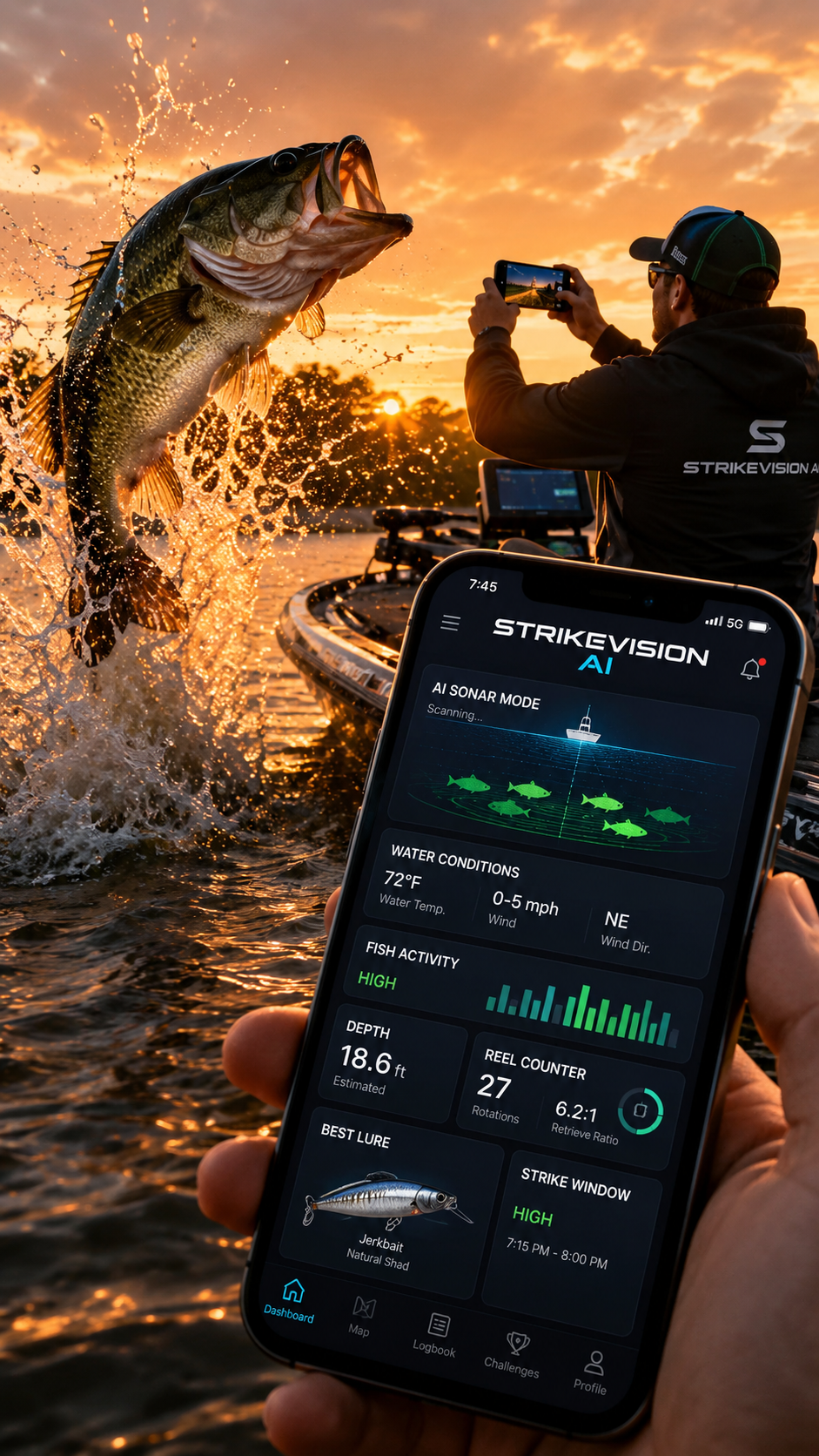
Compare your lure, line and retrieve to make a more informed cast.
Two lures can behave very differently on identical lines. Understanding the main variables is more reliable than relying on one universal depth formula.
Crankbait lips, sinking weights, floating bodies and soft-plastic rigs create different underwater paths.
Thicker line can increase drag. Line characteristics influence the depth that some lures reach.
Steady cranking, pauses and acceleration change how sinking and diving lures behave.
Cast length and rod-tip height can change how far and how long a lure runs near its target depth.
Current and drift can add or subtract movement relative to the lure and change its path.
Retrieve length per handle turn and rigging help determine how quickly line is taken in.
For a lure dropping freely with a known sink rate, multiply the sink rate by the time allowed to sink. Try it below.
This illustrates idealized vertical drop—not actual lure running depth. It is most relevant as a rough starting point for a freely sinking lure, not a crankbait being retrieved.
Assumes a constant sink rate, no retrieval, no line tension and no current. Actual depth may be much different.
The most useful approach depends on what you are casting. These are general strategies, not guaranteed depth ranges.
| Lure type | Primary depth factors | How to improve your estimate |
|---|---|---|
| Diving crankbait | Lip design, cast length, line diameter and retrieve | Use the specific lure's diving chart; test on known-depth structure. |
| Spinnerbait / bladed lure | Head weight, retrieve speed and lift | Count down the lure, then adjust cadence in measured steps. |
| Jig or weighted soft plastic | Head weight, trailer, line drag and current | Observe fall time and bottom contact; make repeatable casts. |
| Suspending jerkbait | Manufacturer running range, line and retrieve pattern | Start with specified range and observe lure response to pauses. |
| Topwater | Designed to fish on or near the surface | Use for surface presentation instead of estimating diving depth. |
Counting handle turns can help you repeat your retrieve consistently. A reel's published inches per turn (IPT) gives a rough sense of how much line each handle rotation collects.
But line retrieved is not the same as underwater lure depth. Spool fill, line angle, lure shape and the water affect the actual lure path.
Your StrikeVision AI homepage describes a lure depth estimator using retrieve speed, line type, reel rotations, lure type, sink rate and fishing conditions. Together with its retrieve coaching and catch memory features, the app is designed to help you compare casts and learn patterns.
Use any reported depth as an estimate, not a direct measurement of what a lure is doing underwater.
A phone-only estimate cannot directly measure a lure underwater. Actual depth depends on lure design, line, retrieve speed, water and other conditions.
Start with manufacturer diving-depth charts, which often depend on line diameter and cast length. Use bottom contact or known-depth structure to refine your approach.
It depends on the lure. A diving crankbait may run differently as speed changes, while a sinking lure may rise with increased retrieve speed.
Line diameter and material can change drag, buoyancy and diving performance. Manufacturer guidance and on-water testing are the best starting points.
No. It estimates idealized drop distance from a user-entered sink rate and elapsed time. It does not measure actual depth or account for line tension, drag, current or retrieve motion.
Explore lure-depth estimates, reel tracking, lure recommendations and catch memory in StrikeVision AI.
ONE-TIME PAYMENT · NO MONTHLY SUBSCRIPTION
OPEN STRIKEVISION AIPrice as advertised on the StrikeVision AI homepage. Confirm final purchase terms in the app.